1/22/2026
Good Day,
This January uncertainty rules the day as we march into 2026. Below are some of the factors that may impact you.
DID YOU KNOW?
-
There are around 6.8 million construction workers in the US today: Around 30% are foreign-born, a little over 2 million. Around 1.4-1.6 million are undocumented. Today, the industry is short 300,000 workers, according to the National Association of Homebuilders. Estimates put the national housing shortage somewhere between 1.5 million and 5 million homes. (NY TIMES)
-
The number of billionaires reached more than 3,000 in 2025, and collectively their fortunes increased by 16%, or $2.5 trillion. The world's billionaires’ wealth has surged by 81% since 2020. US median household net worth rose roughly 33% since 2020. (CNBC)
-
Existing-home sales jumped 5.1% in December, the strongest reading in nearly three years, even after adjusting for seasonal factors, the National Association of REALTORS® reported Wednesday. Sales are up 1.4% from a year ago. December’s gain followed a smaller increase in November, also tied to the drop in mortgage rates that was set in motion this past fall.
It’s the type of building momentum the housing market has been waiting for. After all, “2025 was another tough year for home buyers, marked by record-high home prices and historically low home sales,” says Lawrence Yun, NAR’s chief economist. “However, in the fourth quarter, conditions began improving, with lower mortgage rates and slower home price growth.” (NAR)
-
The 10-Year Treasury jumped close to 4.3% overnight just as the mortgage market was getting some relief.... Gold jumped past $4,700, up 71.5% in a year, and the dollar has depreciated by over 12% in a year. (CNBC)

Interest Rates
Jan. 20. 2026
Jumbo 30YR Fixed Purchase: 6.125% or 5.875% with 1% in point
Jumbo Purchase ARM: 5.75% - No Points
Conforming 30YR Fixed Purchase: 5.990% - No Points
FHA 30YR Fixed Purchase: 5.490% - No Points
Down Payment Assistance Programs: 5.625% for 100% financing
Mortgage Ally as of 1.22.26 Qualifications must be verified for eligibility. Micah Ascarrunz (510)520-2612. NMLS 447762

Tax Code Changes 2026
Federal (IRS) Changes for Homeowners and small investors.
The 2026 tax year introduces relief for many homeowners.
-
SALT Deduction Cap Increase: The $10,000 cap on State and Local Tax (SALT) deductions has been significantly raised for 2026. For those with a Modified Adjusted Gross Income (MAGI) under $500,000, the cap is now $40,000. This is a major win for homeowners in high-tax states like California.
-
Mortgage Interest Deduction: The $750,000 limit on deductible mortgage debt (for loans taken after 2017) has been made permanent.
Changes for Small Investors
Small-scale landlords and "fix-and-flip" investors
-
100% bonus depreciation has been permanently restored. This allows investors to immediately deduct the full cost of qualifying short-life assets (like appliances, carpeting, and landscaping) in the first year rather than over decades.
-
Section 199A (Pass-Through) Deduction: The 20% deduction for Qualified Business Income (QBI), which many small landlords use to shield rental income, was made permanent.
-
1031 Exchanges: Despite rumors of caps, Section 1031 "Like-Kind" exchanges remain fully intact with no dollar limit on deferrals for 2026.
California Specific
-
Proposition 19 (Inheritance Rules): These rules remain a critical factor in 2026. If you inherit a home from a parent, you only keep their low tax basis if you move into the home as your primary residence within one year. If you keep it as a rental, it will be reassessed to full market value.
-
FinCEN Reporting for Cash Deals: Beginning March 1, 2026, new federal rules enforced in California require reporting on all-cash residential purchases made through legal entities (LLCs, Trusts). This aims to increase transparency for small investment entities.
Zoning & ADUs: California continues to mandate "up-zoning" near transit hubs. In 2026, it is easier for small investors to convert single-family lots into multi-unit properties or add ADUs (Accessory Dwelling Units) due to reduced local permit "shot-clock" times.
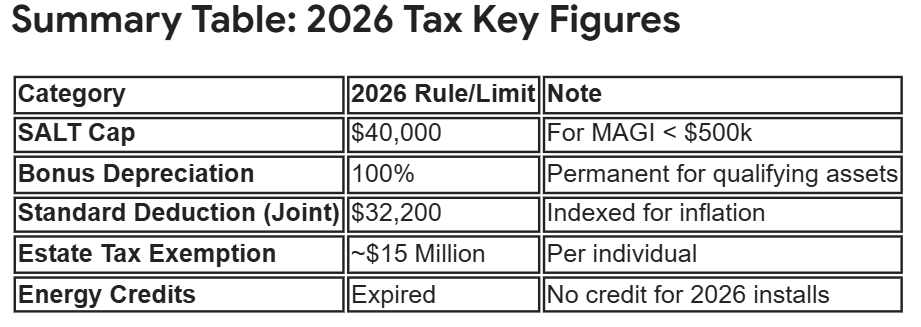
These and other tax regulations highlights are highly specific to your personal situation, should be examined in detail and always be implemented on the advice of a professional CPA or financial advisor.
Home Sweet Home

-
Is the 'Flood Score' akin to 'Zestimates'....possibly not as consistently accurate as they might claim to be? Until November 2025, all the major listing platforms showcased scores from First Street, a small but influential climate-research company. It rates homes by their vulnerability to wildfire, flood, wind, heat and poor air quality. A backlash from the real-estate industry prompted Zillow in November to remove the scores from display, while still allowing buyers to click through to the data. Other listings sites still show the scores, but some will suppress them if a seller objects. Should buyers see what insurance companies see and base their decisions on? (WSJ)
-
Curves continue to take precedence over sharp corners in dining rooms, with round tables and organic shapes set to lead the way this year. 'Bringing softness and flow to the dining space, these silhouettes help to create interiors that feel calmer and more nurturing, offering a welcome contrast to the clean, linear forms that have dominated in recent years,' says Amanda Huber, creative director of The Dining Chair Company. (HB)
-
As far as 2026 dining room trends go, designers are leaning into intentional functionality. 'We're seeing a definite shift back towards more defined, closed floor plans for formal dining,' says Imparfait Design Studio's creative director and co-founder, Rebekah Zaveloff. (House Beautiful)
Bay Area Market Reports

“Young renters would rather deal with a good app than a person.” Senior vice president at a public REIT
Around the World

-
China: Since 2021, as the Chinese property market has descended into crisis, analysts have paid close attention to its woes—a task that is now becoming increasingly difficult. In mid-December Beijing’s housing authority announced that it would stamp out social-media accounts responsible for negative posts; thousands have since been closed or suspended. Estate agents are being pressed to keep ugly intelligence under wraps. (The Economist)
-
Real estate is poised to play a significant role in the great wealth transfer. Gen Xers and Millennials are set to inherit $4.6 trillion in global real estate over the next 10 years, according to the report, which incorporated data from research firms Altrata and Cerulli Associates. Nearly $2.4 trillion of that property is located in the U.S. “The price points have just gone wild,” said Ian Slater, a Compass agent who works with ultrawealthy families in New York. “I used to commonly see people buy $3 million to $5 million apartments for their 25- to 30-year-old kids. Now I see people buying $15 to $30 million apartments for their kids.” (WSJ)
COMPASS Catch- Updated Luxury Listings

Do you have friends or family in need of Real Estate assistance? My team is here to help, ask for my Cost & Performance Guarantee
My best wishes to you and yours,
Katherine
